

AI Agents for Loan Origination
AI Agents for Loan Origination
AI Agents for Loan Origination
Accelerating multifamily and commercial real estate loan processing with AI-powered document intelligence.

Enablingloanoriginatorstoclosedealsfasterbyautomatingdocumentreviews,flaggingrisksearly,andguidingnextactionswithAIagents.
Enablingloanoriginatorstoclosedealsfasterbyautomatingdocumentreviews,flaggingrisksearly,andguidingnextactionswithAIagents.
Enablingloanoriginatorstoclosedealsfasterbyautomatingdocumentreviews,flaggingrisksearly,andguidingnextactionswithAIagents.
Challenge
Challenge
Commercial real estate loan origination is document-heavy, high-risk, and hard to scale. Loan originators and underwriters spend hours per deal:
Chasing missing or outdated documents
Reconciling inconsistencies across records
Repeating manual checks under tight timelines and regulatory pressure
As deal volume grows:
Per-loan costs increase, often requiring more analysts or underwriters
Mistakes can lead to rework, delayed decisions, or financial risk
Commercial real estate loan origination is document-heavy, high-risk, and hard to scale. Loan originators and underwriters spend hours per deal:
Chasing missing or outdated documents
Reconciling inconsistencies across records
Repeating manual checks under tight timelines and regulatory pressure
As deal volume grows:
Per-loan costs increase, often requiring more analysts or underwriters
Mistakes can lead to rework, delayed decisions, or financial risk
Commercial real estate loan origination is document-heavy, high-risk, and hard to scale. Loan originators and underwriters spend hours per deal:
Chasing missing or outdated documents
Reconciling inconsistencies across records
Repeating manual checks under tight timelines and regulatory pressure
As deal volume grows:
Per-loan costs increase, often requiring more analysts or underwriters
Mistakes can lead to rework, delayed decisions, or financial risk
Commercial real estate loan origination is document-heavy, high-risk, and hard to scale. Loan originators and underwriters spend hours per deal:
Chasing missing or outdated documents
Reconciling inconsistencies across records
Repeating manual checks under tight timelines and regulatory pressure
As deal volume grows:
Per-loan costs increase, often requiring more analysts or underwriters
Mistakes can lead to rework, delayed decisions, or financial risk
Solution
An AI-powered loan origination copilot composed of a workforce of specialized AI agents, each responsible for a narrowly scoped task across document intake, validation, analysis, and communication.
Rather than replacing loan officers, these agents act as copilots embedded into existing workflows and supporting decision-making while preserving human oversight.
A coordinated workforce of AI agents, each handling a specific task, replicates and improves the loan origination workflow. Together, they streamline manual processes, verify key information, execute actions, and deliver detailed deal insights to guide officers’ decisions.
My Role
Defined AI strategy, trade-offs, and adoption frameworks for senior stakeholders, aligning product, ML, and compliance priorities while positioning LenderIQ for competitive differentiation.
Oversaw teams to create end-to-end datasets for AI training and evaluation, mentoring them to think like underwriters and build repeatable, high-stakes intelligence.
This case study demonstrates my approach to designing AI in regulated, high-risk environments where trust, compliance, and evaluation boundaries matter more than novelty.
Defined AI strategy, trade-offs, and adoption frameworks for senior stakeholders, aligning product, ML, and compliance priorities while positioning LenderIQ for competitive differentiation.
Oversaw teams to create end-to-end datasets for AI training and evaluation, mentoring them to think like underwriters and build repeatable, high-stakes intelligence.
This case study demonstrates my approach to designing AI in regulated, high-risk environments where trust, compliance, and evaluation boundaries matter more than novelty.
Modeled Business Impact
Modeled Business Impact
Based on pilot observations + conservative underwriting benchmarks
Cut 25–40% of manual review time
15–20 hours per deal → 4–8 hours saved. LenderIQ speeds up manual review and deal progression.
Cut 25–40% of manual review time
15–20 hours per deal → 4–8 hours saved. LenderIQ speeds up manual review and deal progression.
Cut 25–40% of manual review time
15–20 hours per deal → 4–8 hours saved. LenderIQ speeds up manual review and deal progression.
Cut 25–40% of manual review time
15–20 hours per deal → 4–8 hours saved. LenderIQ speeds up manual review and deal progression.
95% Accuracy on data extraction & anomaly detection
Field-level evaluation and dataset QA dramatically improved reliability and reduced false positives.
95% Accuracy on data extraction & anomaly detection
Field-level evaluation and dataset QA dramatically improved reliability and reduced false positives.
95% Accuracy on data extraction & anomaly detection
Field-level evaluation and dataset QA dramatically improved reliability and reduced false positives.
95% Accuracy on data extraction & anomaly detection
Field-level evaluation and dataset QA dramatically improved reliability and reduced false positives.
$150K–$450K Annual Saving
Mid-sized lenders save on underwriting hours without adding underwriiters.
$150K–$450K Annual Saving
Mid-sized lenders save on underwriting hours without adding underwriiters.
$150K–$450K Annual Saving
Mid-sized lenders save on underwriting hours without adding underwriiters.
$150K–$450K Annual Saving
Mid-sized lenders save on underwriting hours without adding underwriiters.
How it works
How it works
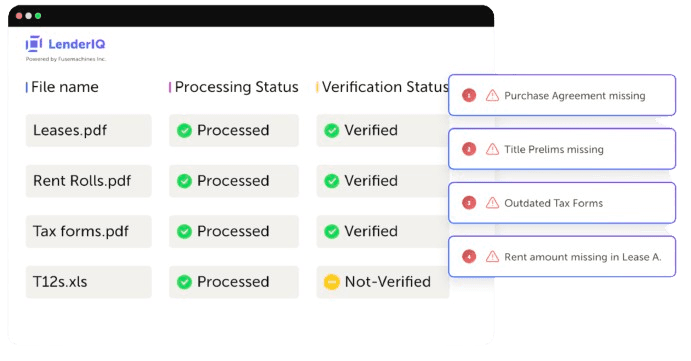
Verify DOCUMENTS
Verifies that all borrower documents are submitted, complete, up to date, while confirming they belong to the same borrower.

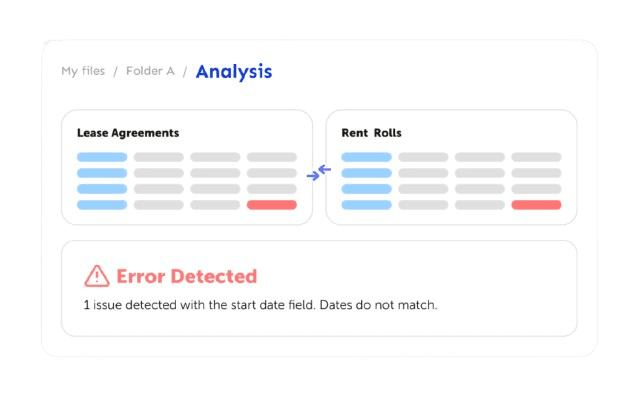
DETECT & FLAG ANOMOLIES
Compares documents to flag discrepancies in entities, figures, and critical terms, to reduce risk and prevent downstream issues.

TRIAGE ACTIONS
Generates ready-to-send messages, notes and CRM tasks with full context, helping teams triage issues and take next steps faster.
DEAL-SPECIFIC CHATBOT
Answers deal-specific questions by pulling precise information directly from relevant documents, eliminating the need to sift through files.
Key Decisions I made
Key Decisions I made
Built trustworthy AI through high-quality data
Defined extraction schemas, audited ground-truth datasets, and enforced rigorous QA of complex loan documents before training AI.
Impact: Stabilized AI performance, eliminated downstream trust issues, and ensured reliable outputs for high-stakes underwriting.
Defined extraction schemas, audited ground-truth datasets, and enforced rigorous QA of complex loan documents before training AI.
Impact: Stabilized AI performance, eliminated downstream trust issues, and ensured reliable outputs for high-stakes underwriting.
Defined extraction schemas, audited ground-truth datasets, and enforced rigorous QA of complex loan documents before training AI.
Impact: Stabilized AI performance, eliminated downstream trust issues, and ensured reliable outputs for high-stakes underwriting.
Prioritized critical workflows and made AI actionable
Focused on the most time-consuming documents and structured AI outputs to guide human review.
Impact: Surfaced issues earlier, improved accuracy from ~60% to 95%, and enabled safe, confident adoption without disrupting existing processes.
Focused on the most time-consuming documents and structured AI outputs to guide human review.
Impact: Surfaced issues earlier, improved accuracy from ~60% to 95%, and enabled safe, confident adoption without disrupting existing processes.
Focused on the most time-consuming documents and structured AI outputs to guide human review.
Impact: Surfaced issues earlier, improved accuracy from ~60% to 95%, and enabled safe, confident adoption without disrupting existing processes.
Structured AI outputs as a product capability
Designed evaluation frameworks to categorize confidence, guide human review, and define safe automation boundaries.
Impact: Enabled predictable, explainable AI behavior, reducing errors and building user trust in critical financial workflows.
Designed evaluation frameworks to categorize confidence, guide human review, and define safe automation boundaries.
Impact: Enabled predictable, explainable AI behavior, reducing errors and building user trust in critical financial workflows.
Designed evaluation frameworks to categorize confidence, guide human review, and define safe automation boundaries.
Impact: Enabled predictable, explainable AI behavior, reducing errors and building user trust in critical financial workflows.
The Process
The Process
Discovery & Problem Framing

Conducted discovery with 15+ lenders across small, mid-sized, and larger institutions
Identified 45+ manual tasks across the loan origination lifecycle suitable for AI assistance
Mapped required documents, dependencies, validity rules, and review logic
Key insight: ROI for small and mid-sized lenders comes from end-to-end efficiency, not isolated automation.
This phase was also critical for understanding how large organizations evaluate where to invest, which markets to enter, and what products are worth building. Rather than starting from a predefined AI use case, we examined lender workflows end-to-end to identify where cost, risk, and effort were most concentrated and where AI could create meaningful ROI.
Not every identified task was worth solving. Some were too edge-case driven, others lacked sufficient volume, and some would have required changes to core lender processes that would slow adoption. These insights informed deliberate go/no-go decisions and helped narrow focus to areas where AI could leverage our strengths while avoiding problems better solved through process or operational changes.
This approach ensured the product was anchored not just in technical feasibility, but in strategic fit, balancing market opportunity, customer readiness, and our ability to execute reliably.
Discovery & Problem Framing
Conducted discovery with 15+ lenders across small, mid-sized, and larger institutions
Identified 45+ manual tasks across the loan origination lifecycle suitable for AI assistance
Mapped required documents, dependencies, validity rules, and review logic
Key insight: ROI for small and mid-sized lenders comes from end-to-end efficiency, not isolated automation.
This phase was also critical for understanding how large organizations evaluate where to invest, which markets to enter, and what products are worth building. Rather than starting from a predefined AI use case, we examined lender workflows end-to-end to identify where cost, risk, and effort were most concentrated and where AI could create meaningful ROI.
Not every identified task was worth solving. Some were too edge-case driven, others lacked sufficient volume, and some would have required changes to core lender processes that would slow adoption. These insights informed deliberate go/no-go decisions and helped narrow focus to areas where AI could leverage our strengths while avoiding problems better solved through process or operational changes.
This approach ensured the product was anchored not just in technical feasibility, but in strategic fit, balancing market opportunity, customer readiness, and our ability to execute reliably.
Discovery & Problem Framing
Conducted discovery with 15+ lenders across small, mid-sized, and larger institutions
Identified 45+ manual tasks across the loan origination lifecycle suitable for AI assistance
Mapped required documents, dependencies, validity rules, and review logic
Key insight: ROI for small and mid-sized lenders comes from end-to-end efficiency, not isolated automation.
This phase was also critical for understanding how large organizations evaluate where to invest, which markets to enter, and what products are worth building. Rather than starting from a predefined AI use case, we examined lender workflows end-to-end to identify where cost, risk, and effort were most concentrated and where AI could create meaningful ROI.
Not every identified task was worth solving. Some were too edge-case driven, others lacked sufficient volume, and some would have required changes to core lender processes that would slow adoption. These insights informed deliberate go/no-go decisions and helped narrow focus to areas where AI could leverage our strengths while avoiding problems better solved through process or operational changes.
This approach ensured the product was anchored not just in technical feasibility, but in strategic fit, balancing market opportunity, customer readiness, and our ability to execute reliably.
Discovery & Problem Framing
Conducted discovery with 15+ lenders across small, mid-sized, and larger institutions
Identified 45+ manual tasks across the loan origination lifecycle suitable for AI assistance
Mapped required documents, dependencies, validity rules, and review logic
Key insight: ROI for small and mid-sized lenders comes from end-to-end efficiency, not isolated automation.
This phase was also critical for understanding how large organizations evaluate where to invest, which markets to enter, and what products are worth building. Rather than starting from a predefined AI use case, we examined lender workflows end-to-end to identify where cost, risk, and effort were most concentrated and where AI could create meaningful ROI.
Not every identified task was worth solving. Some were too edge-case driven, others lacked sufficient volume, and some would have required changes to core lender processes that would slow adoption. These insights informed deliberate go/no-go decisions and helped narrow focus to areas where AI could leverage our strengths while avoiding problems better solved through process or operational changes.
This approach ensured the product was anchored not just in technical feasibility, but in strategic fit, balancing market opportunity, customer readiness, and our ability to execute reliably.